

The Disconnect
Research by Junior Achievement and Basinait Insights conducted in March of 2026 shows that more than 90 percent of education leaders surveyed agree with the statement, “There is a disconnect between what is taught in primary and secondary schools and what it takes for students to succeed economically in the future.”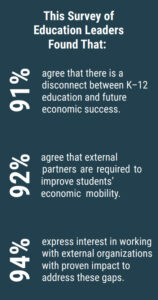
This response potentially reflects a recognition that while schools can provide strong academic foundations, too many students are graduating without the skills, experience, and practical exposure needed to translate learning into long-term economic opportunity.
These findings may reflect an age-old dynamic around the purpose of education: is it meant to prepare a person for life? Or to prepare the person for work? At Junior Achievement, we believe it must be both. And that’s especially true when the skills needed to make students lifelong learners – critical and creative thinking,
problem solving, communication, collaboration – are also the same ones expected to help students succeed in a future being reshaped by forces like AI, automation, and globalization
Speaking of AI
No force highlights the current and potentially growing disconnect between education and economic outcomes more than recent advances in artificial intelligence. AI is changing how work happens, what skills matter, and what future readiness demands.
According to the Basinait Insights survey, 93 percent of education leaders say it is extremely or very important for education organizations to focus on AI as part of work readiness, including how to question AI, evaluate it, and apply it responsibly. While technical skills may open doors, human advantage skills – such as durable or transferable skills – determine how far students go. Together, they can define a new vision of career readiness for the future.

Bridging the Disconnect
A topline conclusion from all of this research is clear: collaboration between districts and external partners is no longer optional, its mission critical in the face of our rapidly changing world.
From Junior Achievement’s perspective, offerings once viewed as supplemental must now be part of the strategic infrastructure, bringing in specialized expertise, expanding career-connected learning, and accelerating innovation. School systems are no longer adequately served by episodic engagements brought in by outside providers formed to check boxes that exist for purposes unrelated to what’s best for students. Partners need to provide meaningful and measurable learning experiences that integrate seamlessly while aligning with district priorities and delivering proven educational outcomes.
At the center of future partnerships is a singular priority: career education that utilizes career-connected learning, tying students’ academic progression to economic outcomes.
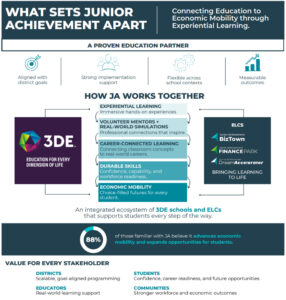
It’s important that education leaders have partners that can demonstrate real impact, including:
- Clear alignment with district goals
- Strong implementation support
- Flexibility across school contexts
- Measurable outcomes
Among those surveyed who are familiar with Junior Achievement: 88 percent believe JA advances economic mobility and expands opportunities for students.
Junior Achievement is a leader in experiential learning by providing immersive, hands-on learning experiences connecting classroom concepts to real-world scenarios.
By leveraging volunteer professional mentors, interactive simulations, and focusing on practical “durable skills,” JA helps students bridge the gap between education and the workforce.
Through its 3DE school model and Experiential Learning Centers (ELCs), Junior Achievement transforms education into actionable, relevant experiences that lead to higher graduation rates, college enrollment, and career preparation.
Using career-connected learning, Junior Achievement is invested in accelerating economic mobility through education. By helping students become confident, capable, and connected today, we can ensure they have choice-filled futures tomorrow.
Study Methodology
Conducted by Basinait Insights, this study was designed to evaluate how school system leaders use and perceive external education partners, including their satisfaction, priority partnership areas, and likelihood of future engagement.
Respondents were invited via an online panel and call verification program to take the online survey. Junior Achievement was not identified as the study sponsor, but the topic of youth education programs was included as part of the invitation description.
After screening for involvement in school systems, as well as respondents’ roles personally within them, 195 usable surveys were completed. Survey respondents consisted of superintendents, regional superintendents, chiefs of schools, chief academic officers, and school board members. The study was fielded between March 2 and March 9, 2026.
